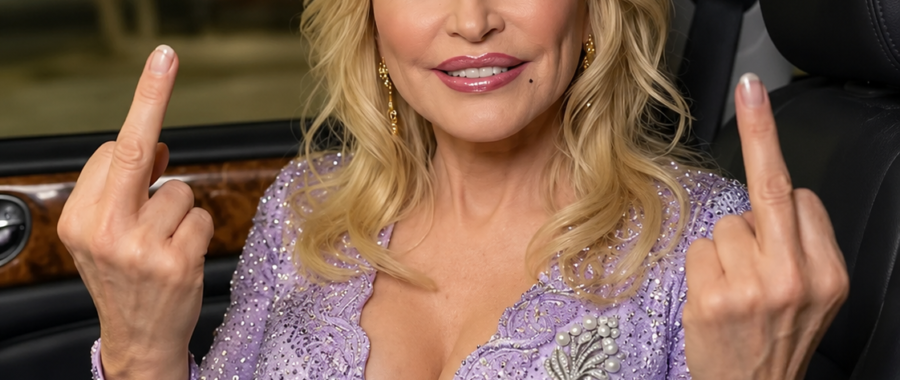
For decades, Dolly Parton has existed in the American consciousness as a secular saint. With her bedazzled gowns, sky-high blonde hair, and a repertoire of songs that touch the deepest corners of the human heart, she has been the undisputed icon of sweetness. Her brand is built on unconditional kindness, the “Dollywood” dream, and a deliberate refusal to enter the fray of polarized politics.
However, silence is not synonymous with ignorance, and kindness is not the same as weakness. Recently, a firestorm erupted as the veneer of the “gentle country icon” appeared to shatter, giving way to a raw, unfiltered critique of the American electorate. The message is blunt, uncomfortable, and deeply divisive: The time for playing nice is over. The icon has officially “torn away” her gentle image to confront those who placed their trust in the wrong ballot.
The Illusion of “I Didn’t Know”
The core of the recent controversy centers on a scathing indictment of voter culpability. For years, the defense used by a significant portion of the electorate has been a variation of the phrase, “I didn’t know it would turn out this way.” It is a convenient narrative—a safety net for the conscience. It suggests that the chaos of the current era—the gutting of healthcare, the erosion of reproductive rights, the volatile international standing, and the degradation of public discourse—was an unforeseen consequence of a populist gamble.
But is that truly the case? Or is it a collective delusion designed to shield the individual from the weight of their own choices?
When the curtain is pulled back, the evidence of what was promised versus what was delivered becomes impossible to ignore. Critics argue that the warning signs were not hidden in the fine print; they were shouted from the rooftops. To claim ignorance is to admit to a profound lack of civic engagement. In the digital age, where information is a currency available at our fingertips, “not knowing” is no longer an excuse; it is a choice. It is the choice to inhabit an echo chamber, to prioritize the glamour of a notorious figure over the dry, often unexciting requirements of true competence and integrity.
The Mirror of the Ballot Box
If you are currently looking around, witnessing the fraying edges of society, and asking, “How did we get here?” the answer is not found in the stars or in complex geopolitical theories. It is found in the physical act of marking a ballot on election day.
The ballot box is the ultimate mirror. It reflects the values, priorities, and biases of a nation at a specific moment in time. When a population chooses a leader based on the size of their ego rather than the depth of their policy; when they prioritize the performance of power over the practice of governance; when they are seduced by the spectacle of scandal, they are not just electing an individual—they are endorsing a worldview.
The current fallout is a direct reflection of that endorsement. We see a healthcare system stripped of its safety nets, leaving the most vulnerable exposed. We see the reversal of decades of progress regarding personal and civil rights. We see a nation that once served as a beacon of stability now viewed with a mixture of confusion and pity by the international community. This is not the work of an external enemy; it is the internal combustion caused by a deliberate electoral choice.
The Ego Over the Institution
Perhaps the most stinging part of this critique is the characterization of the leader as a “third-rate businessman with a massive ego.” The contrast between this archetype and a leader with genuine qualifications is stark. A true leader understands that they are merely a steward of an institution, not its owner. They understand that the office is greater than the occupant.
In contrast, the populist model thrives on the inverse: the occupant is greater than the institution. In this dynamic, anyone who stands up to the leader’s ignorance is viewed not as a patriot or a dissenting voice, but as an enemy to be punished. This atmosphere of retribution creates a vacuum of intellect. When you surround a leader with “yes-men” and ostracize the experts, you are left with a government that is hollowed out, incapable of navigating complex problems, and obsessed with maintaining the optics of strength rather than the substance of progress.

The Price for Future Generations
The most profound tragedy is that the “mistake of a lifetime” is not confined to the life of the voter. It is a debt inherited by the next generation. We are currently spending the political and social capital that our predecessors labored to build.
When rights are reversed and the rule of law is treated as a flexible suggestion, the structure of democracy begins to tilt. It is a slow, steady erosion that is difficult to stop once it gains momentum. The generation that will inherit this landscape will not care about the “reasons” or the “excuses” for why the current path was chosen. They will only have to live with the consequences of a hollowed-out healthcare system, a diminished global influence, and a culture that has replaced debate with destruction.
The Call to Sobriety
To hear a figure like Dolly Parton—or to encounter a discourse that adopts such a sharp, uncharacteristic tone—is a jolt to the system. It forces us to confront the uncomfortable reality that our political identities have become so rigid that we are willing to sacrifice the nation’s health for the sake of our ego.
The question posed is not one of apology, but of sobriety. Are you sober enough to look at the current reality without the filter of your preferred partisan news outlet? Are you capable of acknowledging that a historical mistake was made, not because you are “evil,” but because you were led by a desire for a spectacle rather than a desire for stability?
Defending a decision to the grave does not make it the right one. It only ensures that the error is repeated. True growth, both as an individual and as a nation, requires the ability to admit when we have been wrong. It requires the courage to say, “I saw the shine, but I missed the rot.”
Conclusion: The Hard Truth
The transition from an icon of sweetness to a voice of cold, hard truth is a symptom of a desperate time. It suggests that the middle ground has been burnt to the ground and that the only language left to speak is that of raw reality.
Do you dare listen to these words? It is easy to dismiss them as “harsh” or “hateful.” It is easy to retreat into defensive indignation. But the truth does not require your permission to be true. The truth about your vote remains, etched in the current state of the nation. The glamour has faded, the scandals have accumulated, and the bill for our collective hubris has come due.
The era of “I didn’t know” is over. We know now. The question is no longer about what happened in the past, but what we are going to do about the future. Will you continue to defend the indefensible, or will you accept the reality, learn the lesson, and finally start making choices that serve the country rather than the ego? The ballot box is waiting for the next round of choices, and the stakes have never been higher.