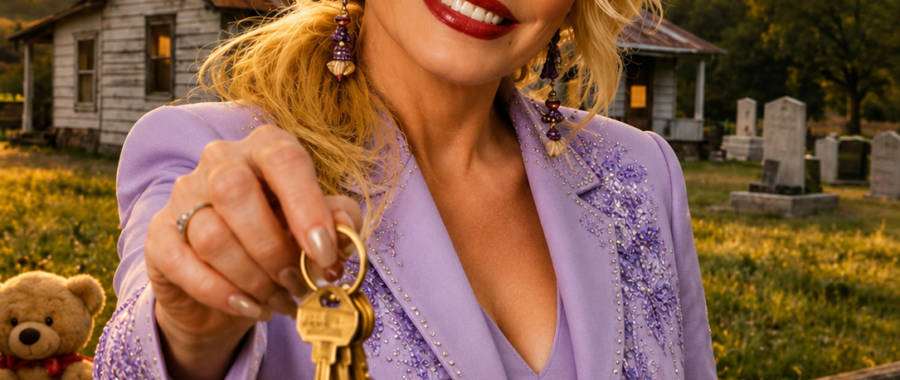
For more than half a century, Dolly Parton has given the world unforgettable songs, unforgettable stories, and unforgettable moments. Her voice has echoed through concert halls, country roads, family kitchens, and countless hearts across generations. Millions know her as a legendary songwriter, an extraordinary entertainer, and one of country music’s most recognizable voices. But perhaps the most remarkable chapter of her legacy has never depended on applause.
Some gifts are loud enough to make headlines.
Others are so quiet that they are only understood by the people whose lives they change.
That may be the truest description of what Dolly Parton has built—not merely through music, but through compassion.
Imagine a place where grief is welcomed instead of hidden.
A place where memories are honored instead of forgotten.
A place where hope quietly grows even after heartbreak.
That is the spirit behind what many people now describe as one of Dolly’s greatest acts of kindness—a sanctuary built not from fame or fortune, but from memory, mercy, and hope.
Throughout her career, Dolly has never separated success from service. Long before philanthropy became a defining part of celebrity culture, she quietly made helping others a natural extension of who she was. Whether supporting literacy, disaster relief, education, or families in need, her generosity has never felt like a campaign. It has always felt personal.
Perhaps that is why this quiet gift resonates so deeply.
Unlike awards displayed on shelves or records hanging on walls, a sanctuary exists for people during moments when they need comfort the most. It asks for nothing in return. It simply offers peace.
There is something profoundly beautiful about the idea that one of the world’s most celebrated performers continues to create spaces where the spotlight fades and humanity takes its place.
It reflects the woman people have admired for decades.
Behind the sparkling outfits, the unmistakable smile, and the legendary voice has always been someone who understands that kindness rarely needs an audience.
Dolly has often spoken about remembering where she came from.
Growing up in the mountains of Tennessee taught her lessons that fame could never replace. She learned that neighbors helped neighbors, families leaned on one another, and even people with very little could still give generously.
Those values never disappeared.
They simply grew larger as her influence grew.
Perhaps that is why people trust her in a way that goes beyond admiration.
They believe her kindness because they have watched it remain consistent through decades of extraordinary success.
Many celebrities become famous for what they achieve.
Very few become beloved because of how they make people feel.
Dolly Parton belongs to that rare second group.
Her greatest accomplishments cannot always be measured by chart positions or ticket sales.
Instead, they are measured by the children who discovered the joy of reading through books she helped provide.
They are measured by communities that found support during difficult times.
They are measured by strangers who found encouragement simply because someone they admired chose compassion over recognition.
This quiet sanctuary feels like another expression of that same philosophy.
It is less about constructing a physical place and more about creating emotional refuge.
Every meaningful sanctuary begins with a simple idea.
Someone deserves to feel safe.
Someone deserves to be remembered.
Someone deserves hope.
Those principles have quietly shaped Dolly’s life for decades.
In today’s world, where so much attention is devoted to visibility, popularity, and instant reactions, choosing quiet compassion almost feels revolutionary.
The loudest voices often dominate headlines.
Yet history frequently remembers the people who spoke softly while changing lives.
Dolly has never needed controversy to remain relevant.
She has never relied on division to remain admired.
Instead, she has demonstrated something increasingly rare.
Consistency.
Year after year, she has shown that kindness is not an occasional act.
It is a lifelong habit.
Perhaps that explains why fans from completely different generations continue discovering her.
Young listeners may first encounter her through a timeless song.
Older listeners remember decades of unforgettable performances.
Yet nearly everyone arrives at the same conclusion.
The music may introduce Dolly Parton.
Her heart is what makes people stay.
There is another reason this quiet gift feels so significant.
Sanctuaries represent healing.
Healing requires remembering.
Remembering often requires mercy.
And mercy creates hope.
Those three words—memory, mercy, and hope—describe far more than a place.
They describe an entire philosophy of living.
Memory reminds us to honor those who came before us.
Mercy teaches us to extend grace to others and ourselves.
Hope gives us courage to continue moving forward, even when life becomes uncertain.
Few public figures have embodied those values as naturally as Dolly Parton.
She has often spoken about gratitude instead of entitlement.
About faith instead of fear.
About lifting people instead of competing with them.
That outlook has become one of the defining characteristics of her legacy.
When people speak about Dolly today, they rarely begin with statistics.
They talk about how she made them smile.
How her songs accompanied important chapters of their lives.
How her generosity inspired them to believe that goodness still exists.
Those stories cannot be measured by numbers.
They live quietly inside families, friendships, and communities.
That may be the greatest achievement any artist could ever hope for.
Long after concerts end and awards gather dust, what remains are the lives touched through simple acts of compassion.
Perhaps that is why this sanctuary feels so symbolic.
It reminds us that legacies are not built solely through extraordinary moments.
They are built through thousands of quiet decisions to care.
To listen.
To remember.
To help.
Every act of kindness leaves behind an invisible echo.
Sometimes that echo becomes a song.
Sometimes it becomes a book placed into a child’s hands.
Sometimes it becomes a comforting place where healing begins.
Whatever form it takes, its true purpose remains the same.
To remind another human being that they are not alone.
Dolly Parton has spent an entire lifetime offering that reminder.
Her voice has comforted broken hearts.
Her laughter has brightened difficult days.
Her generosity has opened doors for people she may never even meet.
That is why so many people believe her quietest gift may indeed become her greatest.
Not because it seeks recognition.
But because it reflects everything she has always represented.
In a world constantly searching for louder headlines, bigger stages, and greater attention, Dolly continues to prove something beautifully timeless.
The most meaningful gifts rarely arrive with fanfare.
They arrive with compassion.
They remain through memory.
And they leave behind hope that continues growing long after the giver has quietly stepped away.
Perhaps that is the true sanctuary Dolly Parton has been building all along—not simply a place, but a legacy where kindness lives, memories are treasured, mercy is freely given, and hope never stops finding its way into another heart.